• Skip to main content
  • Skip to primary sidebar
  • Skip to footer

Outlook Tips

Learning Microsoft Outlook One Tip At A Time

Diane Poremsky [Outlook MVP]

  • Home
  • Tips Archive
  • How to...
  • Beginner
  • Outlook.com

Tip 1005: Outlook pst file size does not shrink

When deleting a large number of Outlook items from a pst file (and emptying the deleted items folder), many users expect to see the pst file size reflect the changes immediately. Unfortunately, that is not how it works with Outlook.

I have one single .pst file of 19GB with subfolders for projects inside. Now I am making separate.pst files for individual projects so I can open them as and when needed but when I move the emails from my master .pst file to other .pst files, it seems it is copying, not moving the messages. My master .pst file is still 19GB, after I copied 10GB of emails into different folders. Can you explain what is happening?

Outlook is designed like a database and the space used by deleted items is not recovered until you shrink the database. Outlook may overwrite the now-unused space as new items are added to the pst, but the pst file needs to be compacted to recover space on the hard disk.

Outlook won't compact the pst file as soon as you move or delete Outlook items. It waits until there is 20% "white space" (space used by the now-deleted items) and the computer is idle to begin compacting. When Outlook begins compacting, it may take several days to recover all of the space as it will stop when the computer is busy and restart when it's idle. For example, it took nearly 3 weeks to fully reduce a pst file after deleting 50 GB of messages.
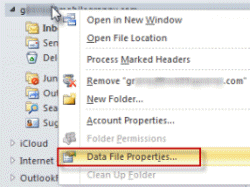
Right click on a pst file to access Data File Properties dialogYou can kick off a manual compact by right clicking on the top level of the pst, choose Data File Properties in Outlook 2010, or Properties in Outlook 2007 and older, then Advanced.

Click Compact Now and have lunch or take a nap while Outlook does it's thing.

Outlook's Compact Now button

Published July 6, 2012. Last updated on December 1, 2011.

Share this:

  • Twitter
  • Facebook
  • LinkedIn
  • More
  • Print
  • Tumblr
  • Reddit
  • Pocket
  • Pinterest

Related posts:

Tip 915: Compact Now Every Time you Exit Outlook Three times last week I received messages that went something like this: "Help me RESCUE data from CRASHED MS BCM! My computeTip 244: Backup BCM databases You can bypass the Deleted Items folder by holding Shift when you delete an Outlook item. Because you are permanently deleting theTip 243: Permanently Deleting Items Do you need to move folders from one pst file to another pst file? Or delete a bunch of folders from a pst? If you’ve tried this bTip 753: Moving Folders
Subscribe
Notify of
4 Comments
Newest
Oldest Most Voted
Inline Feedbacks
View all comments

Primary Sidebar

Search OutlookTips

Training and one-on-one assistance

Do you need help setting up Outlook or want some one-on-one training? I'm available for hire. See Training and one-on-one assistance for fees and to check availability.

All-Time Most Popular Posts

  • Windows 7 and Vista Start Search field
    How to start Outlook in safe mode
  • outlook.com icon
    Delete a message stuck in Outlook's Outbox
  • How to use Outlook's Command line switches
  • Use Cleanviews switch to reset all views
    How to Reset the View on Outlook folders
  • Where are my Outlook Files?
  • Folder paths
    How to Find Folder Paths in Outlook Mailboxes
  • How to use Scanpst.exe to repair Outlook data files
  • Outlook's Missing Holidays
  • backstage page
    Where is File tab in Outlook?
  • Icons found in the Inbox, Message Headers, and Toolbars

Footer

Recent Posts

  • Log into multiple Outlook on the web accounts
  • Keeping Hackers out of Microsoft accounts
  • Microsoft Account Closure Email
  • Outlook on the web Quick Actions moved to the right
  • Automatically sign out of Outlook.com

Recent Bug List

Microsoft keeps a running list of issues affecting recently released updates at Fixes or workarounds for recent issues in Outlook for Windows.

Office Update History

Update history for supported Office versions is at Update history for Office

Resources

Ask questions and share your knowledge in Outlook Forums.

You Might Like

Where is File tab in Outlook?
Using Two-factor authentication
Where are my Outlook Files?
How to use Outlook's Command line switches

© 2003–2026 · Outlook Tips

wpDiscuz
You are going to send email to

Move Comment